
Air Con Energy Efficiency: How to Keep Cool Without Wasting Power

As the British summer gets hotter every year we all start thinking about how to stay comfortable at home or in the office. Nobody wants to sit in a sticky room when it is 30 degrees outside but there is always that worry about the electric bill going through the roof. You might have heard that air conditioning is a massive money pit but things have changed a lot lately. Modern systems are much better at managing power than the old clunky units from years ago. If you are looking to stay chilled without the stress of a huge bill, here is how it works.

Understanding air con energy efficiency

When you start looking at new units you will see a lot of acronyms like eer and seer. These sound complicated but they are just ways to measure how much cooling you get for every pound you spend on electricity. Eer stands for energy efficiency ratio and it tells you how efficient the unit is at a specific moment. Seer is the seasonal version which is more useful for us in the uk because it looks at how the unit performs over a whole summer season.

The higher the number the better it is for your wallet. A modern split system often has a high rating because it uses inverter technology. Instead of the motor turning on and off at full blast like a light switch it works more like a car accelerator. It slows down or speeds up to keep the temperature steady. This is a big deal for air con energy efficiency because it stops those big spikes in power usage that happen when a machine has to work hard to start up again.

At Air Conditioning Direct we see how much of a difference the right setup makes. It is not just about buying the most expensive box on the wall. It is about making sure the unit is the right size for your room. If a unit is too small it will run constantly and still not get the room cold. If it is too big it will keep clicking on and off which wastes power. Getting that balance right is the first step to saving money.

How to boost air con energy efficiency in your home

There are plenty of small things you can do to help your system work better. You do not need to be an expert to make these changes. First off, keep your windows and doors shut when the air con is running. It sounds obvious but you would be surprised how much cold air escapes through a door left ajar. If you leave a window open your unit is basically trying to cool down the whole of London and that is never going to happen.

Another simple trick is to use your blinds or curtains. If the sun is beaming through a south facing window it creates a greenhouse effect. Your air conditioning has to work twice as hard to fight that heat. By closing the curtains during the day you keep the worst of the heat out before it even gets inside.

Maintenance is also a massive factor. If the filters are clogged with dust the air cannot flow properly. This makes the motor work harder and uses more electricity. We always recommend a quick check of your filters every few weeks. It only takes a minute to clean them but it keeps the system breathing easily. A well maintained unit is always going to be more efficient than one that has been ignored for years.

What does it actually cost to run?

Most people think running the air con is like leaving the oven on all day but it really is not. For a standard 2.5kw unit in a bedroom you might only be looking at about 10p to 15p an hour. If you only use it for a few hours in the evening to help you get to sleep it is often cheaper than running a tumble dryer.

The cost depends on your electricity tariff and how hard the unit has to work. If you set the temperature to 18 degrees when it is boiling outside the unit will work flat out but if you set it to a comfortable 22 or 23 degrees it will reach that goal much faster and then just tick over. That small difference in the thermostat setting can have a big impact on your monthly bill.

Using a team like Air Conditioning Direct helps because we look at the details to ensure your installation is optimised. We focus on making sure every part of the system is placed where it can do the most good. If the outdoor unit is stuck in a spot with no airflow it will struggle to dump the heat it has pulled out of your house. Clear space around the units is vital for keeping things running smoothly.

Choosing the right system for you

If you are tired of those cheap portable units that come with a big hose out the window you might want to consider a fixed split system. Portable units are okay for a quick fix but they are usually quite loud and not very efficient. They often pull warm air into the room through gaps in the doors because they are blowing so much air out of the hose.

A fixed split system is much better for long term air con energy efficiency. The noisy part stays outside and the indoor unit is designed to circulate air much more effectively plus they can also act as heat pumps in the winter. This is a bit of a hidden benefit because heat pumps are incredibly efficient at warming a room up. Instead of using a plug in electric heater which is expensive you can use your air con to stay warm for a fraction of the cost.

We have been helping people across London and the home counties for over 25 years at Air Conditioning Direct. We know the local buildings and what works best for different types of properties. Whether you are in a flat in Shoreditch or a house in Essex the goal is the same. You want a system that works without you having to worry about the cost every time you press the power button.

Final thoughts on staying cool

Keeping your home comfortable does not have to be a luxury that breaks the bank. By picking a unit with a good seer rating and doing a bit of basic maintenance you can enjoy a cool house all summer long. Remember to keep those curtains shut when the sun is out and don’t set the thermostat lower than you actually need.

If you are thinking about an upgrade or a new installation we can help you figure out the best path forward. At Air Conditioning Direct we pride ourselves on being honest about what you need and what you don’t for your commercial and residential property. There is no point in overcomplicating things. A simple well installed system will give you the best air con energy efficiency and keep you comfortable for years to come.

If you want to chat more about how we can help your home or business stay cool just get in touch with us at Air Conditioning Direct. We offer a 7 year guarantee on parts and labour for many of our systems so you can have peace of mind that you are making a solid investment. Stay cool and don’t let the heat get to you this year. Contact us today to find out more by calling 020 8989 8989 or completing our online contact form.
Types of Aircon: Which System Actually Suits your Space?

If you’ve been googling types of aircon and feeling more confused the longer you scroll, you’re not alone. Split systems, cassettes, multi-splits, VRF, heat pumps… it all sounds a bit technical when all you really want is a comfortable temperature and a sensible running cost.

As a quick intro, Air Conditioning Direct has been supplying and installing air conditioning across London and the South East for over 25 years, working on everything from studio flats to large offices and commercial kitchens. That day-to-day experience is what this guide is based on – not just theory.

Below, we’ll walk through the main types of aircon used in UK homes and businesses, what each one is good at, and the things to watch out for.

1. Before you choose: what actually matters?

Before we get into the different air conditioning units, it helps to think about:

  • Your space – size of rooms, ceiling height, layout, number of people
  • Use – home vs office, occasional use vs all-day, all-year comfort
  • Electrics and building limits – especially in flats or listed properties
  • Running costs and energy efficiency
  • Noise levels – crucial for bedrooms, studies and meeting rooms
  • Whether you own or rent – affects whether permanent installation is possible

When we visit customers at Air Conditioning Direct, we usually start with a quick site survey and talk through these points in plain English. The “best” system on paper isn’t always the right one for how you actually live or work.

2. Wall-mounted split systems

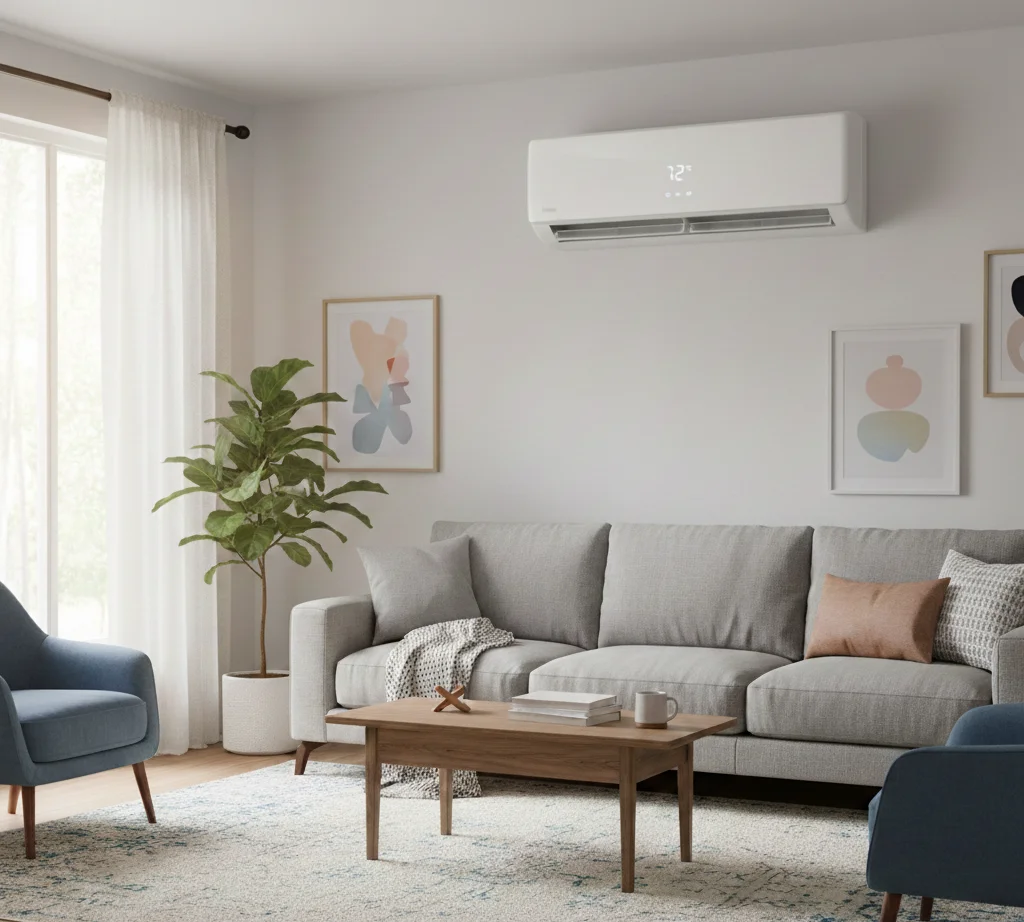
If you picture a typical aircon unit on the wall of a bedroom or office, it’s probably a wall-mounted split system.

What it is:

  • One indoor unit on the wall
  • One outdoor condenser unit usually on a wall, balcony or flat roof

Best for:

  • Bedrooms, lounges and home offices
  • Small to medium commercial rooms
  • Retrofitting in existing properties

Pros:

  • Generally the most cost-effective, all-round option
  • Efficient cooling and heating (many are heat pumps)
  • Quiet operation, ideal for sleeping areas
  • Good control over temperature in individual rooms

Cons:

  • You need somewhere suitable for the outdoor unit
  • You’ll see the indoor unit on the wall (though modern ones are quite sleek)

For many UK homes, a simple wall-mounted split system is the “sweet spot” between performance, price and neatness, which is why we install so many of them.

3. Multi-split systems

Take the idea of a single split system and scale it up and you get a multi-split air conditioning system.

What it is:

  • Several indoor units (often wall-mounted or floor-mounted)
  • Connected to one outdoor unit

Best for:

  • Homes where you want multiple rooms cooled or heated
  • Flats where there’s only space for one outdoor unit
  • Small offices or shops

Pros:

  • Only one outdoor unit, so the exterior of your property looks tidier
  • Independent control of each room
  • Often more efficient than running lots of separate portable units

Cons:

  • Pipework design needs more planning
  • If the outdoor unit fails, several rooms are affected
  • Installation cost is higher than a single split (though still sensible long-term)

For London properties with limited outdoor space, a multi-split system can be a very neat solution.

4. Ducted / central air conditioning

If you want a completely hidden system, ducted aircon is usually the way to go.

What it is:

  • Indoor unit concealed in a loft space, cupboard or suspended ceiling
  • Air distributed via ducts to grills or diffusers in ceilings or walls

Best for:

  • New builds or major refurbishments
  • Larger homes where aesthetics are a priority
  • Offices, shops and other commercial spaces

Pros:

  • Very discreet – all you see are grilles or vents
  • Can serve multiple rooms from one central system
  • Even air distribution, which feels very comfortable

Cons:

  • More invasive installation, often needing ceiling voids or loft space
  • Higher upfront costs than a single split wall unit
  • Design is crucial – poor ductwork equals poor performance

At Air Conditioning Direct we tend to recommend ducted systems when a client is already doing building work or has plenty of ceiling void space to play with.

5. Ceiling cassette units

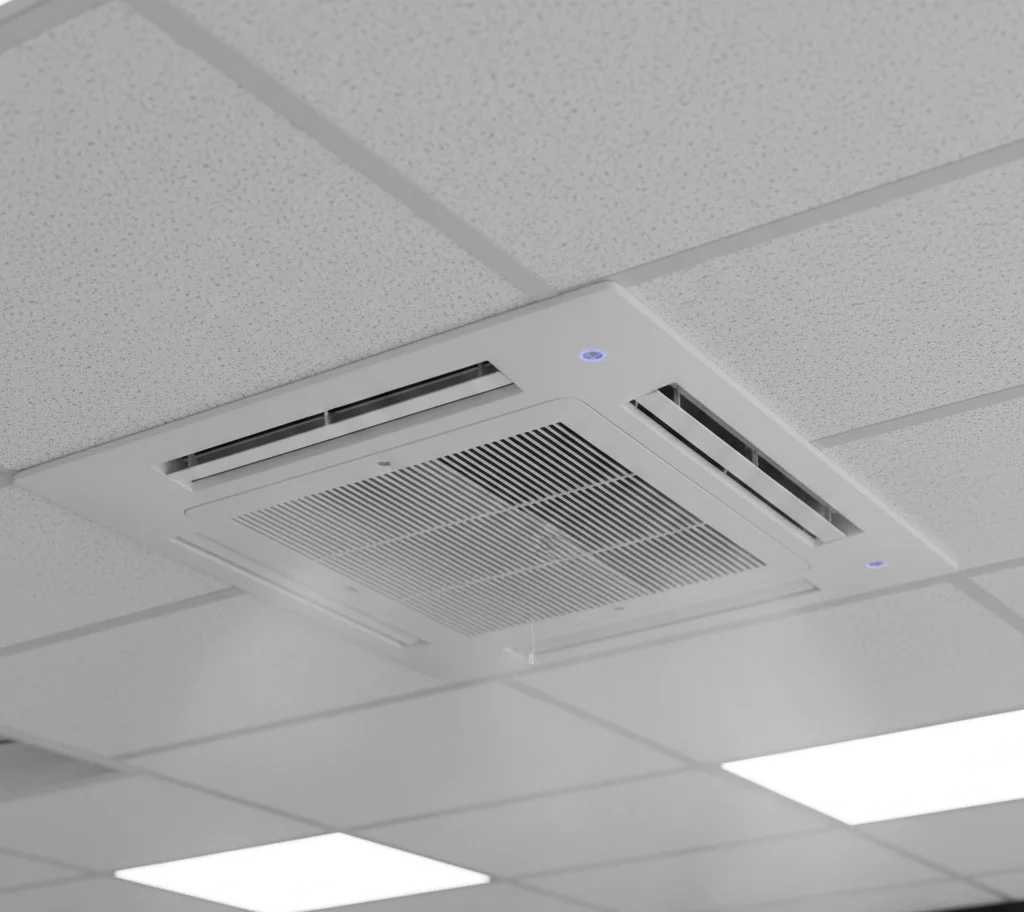
You’ll see ceiling cassette air conditioners in many shops, restaurants and offices.

What it is:

  • Indoor unit recessed into the ceiling grid
  • Air is blown out on two, three or four sides

Best for:

  • Open-plan offices
  • Retail spaces and salons
  • Areas with suspended ceilings

Pros:

  • Great coverage in open spaces
  • Keeps the walls free for shelving or décor
  • Good option when wall space is limited

Cons:

  • Needs a suspended ceiling to hide the bulk of the unit
  • Installation can be more involved than a simple wall unit

If you’ve got a high street shop, café or open-plan workspace and you’re exploring different types of aircon, ceiling cassettes are almost always on the shortlist.

6. Floor-mounted and low-wall units

Think of these a bit like a slimline radiator that also cools.

What it is:

  • Indoor unit installed low down on the wall or on the floor
  • Connected to an outdoor unit like any other split system

Best for:

  • Loft conversions or rooms with sloping ceilings
  • Spaces with very limited high wall space
  • Replacing old storage heaters in some cases

Pros:

  • Good option when a wall-mounted unit is tricky
  • Airflow can feel more natural at seated height
  • Often easier to service if access at height is an issue

Cons:

  • Uses up floor or low wall space
  • Not quite as popular in the UK, so choice can be slightly narrower

We often suggest floor-mounted units in quirky London properties where roof lines and beams make traditional wall units awkward.

7. Portable air conditioners

If you rent or can’t install anything permanent, portable aircon units have their place.

What it is:

  • Stand-alone unit on wheels
  • Usually vents hot air out of a window via a flexible hose

Best for:

  • Renters who can’t alter the property
  • Short-term or occasional use
  • Spot-cooling a room during heatwaves

Pros:

  • No permanent installation required
  • You can move them between rooms
  • Lower upfront cost

Cons:

  • Noisier than fixed systems
  • Less energy efficient
  • You need to manage the exhaust hose and often a window kit
  • Can struggle in larger or south-facing rooms

If you own your home or commercial space and want reliable, year-round comfort, we’ll almost always steer you towards a fixed system rather than relying solely on portable units.

8. Heat pumps and all-year climate control

A lot of modern air conditioning systems are actually air-to-air heat pumps. That means they:

  • Cool in summer by removing heat from the indoor air
  • Heat in winter by extracting warmth from the outside air, even when it feels chilly

For many of our customers, this replaces or reduces the need for traditional electric heating and can be more efficient, especially with well-insulated properties.

If you’re thinking long-term and want both heating and cooling in one system, asking about heat pump-based aircon is a smart move.

9. Matching the type of aircon to real-world scenarios

To make this more concrete, here are a few common setups we see at Air Conditioning Direct:

  • One-bed flat in London:
    Often a single wall-mounted split system in the lounge, sometimes a second in the bedroom, or a small multi-split.
  • Three-bed semi-detached house:
    Wall-mounted units in main bedrooms and lounge, often on a multi-split system, or a small ducted system if there’s a loft and the client wants everything hidden.
  • Small office or salon:
    One or two wall units or a ceiling cassette, depending on layout and ceiling type.
  • Restaurant / open-plan office:
    Usually a mix of ceiling cassettes or ducted aircon with proper zoning and controls.

Every property is different, which is why a site visit and proper design matters. Two spaces of the same size can need different types of aircon depending on insulation, glazing, equipment, people and usage.

10. Why work with Air Conditioning Direct?

Choosing between all these types of aircon is much easier when you’ve got someone experienced in your corner.

At Air Conditioning Direct:

  • We’ve got over 25 years’ experience in residential and commercial air conditioning across London and the surrounding areas
  • We design, supply, install and maintain systems from leading manufacturers
  • We offer up to a 7-year guarantee on selected equipment when we install and maintain it
  • Our engineers are fully qualified and used to working in homes, offices, shops and more

If you’re weighing up your options and want straightforward advice, you can explore more on our website at ac-direct.co.uk or get in touch for a free, no-obligation chat about your space.

Final thought

There’s no single “best” system. The right choice comes down to your property, how you use it and what matters most to you – be that aesthetics, energy efficiency, budget or all-year comfort.

Hopefully this guide has demystified the main types of aircon and given you a clearer idea of where to start. If you’d like tailored recommendations for your home or business, Air Conditioning Direct is here to help, contact us today by calling 020 8989 8989 or completing our online contact form.